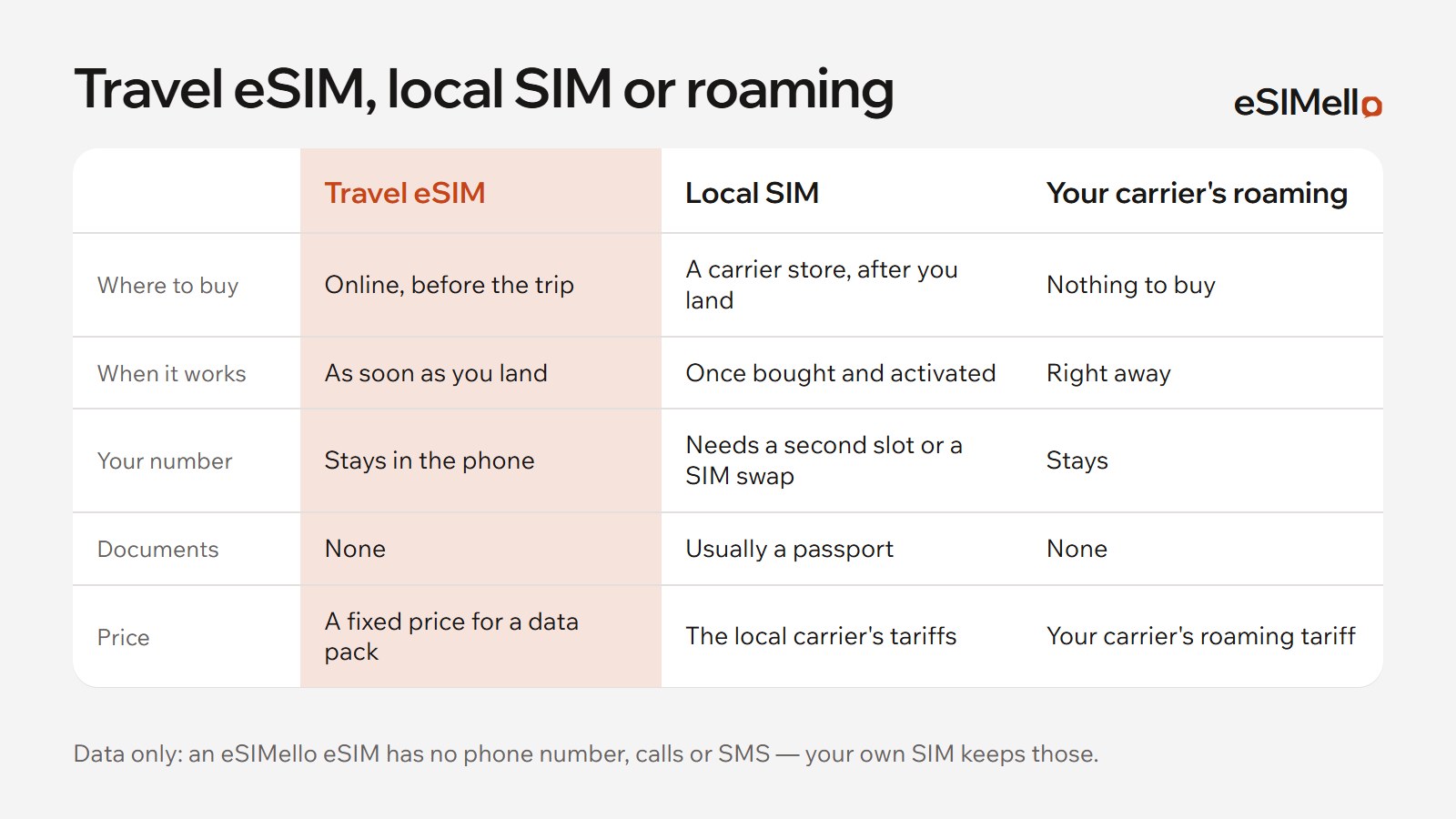
Visiting the United States, you can stay online with your home carrier's roaming, a US prepaid SIM bought after you land, or a travel eSIM installed before you fly. Here is how our US eSIMs work and what to set up.

Our US plans
- Networks: AT&T and Verizon, both with 5G. Each plan's card lists the networks it uses.
- Where the traffic reaches the internet: in the United States, so websites see a US IP address.
- Two kinds of plan: a pack of data for the whole validity, or an allowance for each day. Each plan's card says what speed you get once a day's allowance is used.
- When the validity starts: for almost every plan, when your phone first connects to a network in the US, not when you buy or install the eSIM. Start using it within 180 days of buying it.
- Running low? Top the same eSIM up in My eSIMs, on plans that take a top-up.
Visiting Canada or Mexico too?
The USA & Canada plans cover both countries, and North America adds Mexico. One eSIM then covers the whole trip, with nothing to switch at the border.
Calls, texts and a US number
A travel eSIM is data only: no US phone number, calls or SMS. Your own SIM stays in the phone for calls and texts, which your carrier bills at its roaming rates, so check them before you go. Messaging apps work over the eSIM's data. More in does a travel eSIM have a phone number?

Before you fly, and after you land
- Check that your phone supports eSIM, in our list of devices.
- Buy a plan and install the eSIM at home, on Wi‑Fi: step-by-step guides for iPhone and Android.
- After landing, turn on the eSIM's line, choose it for mobile data and turn on data roaming for it. Abroad, a travel eSIM connects through roaming, at no cost beyond your plan.
- Keep data roaming off for your own SIM, so your home carrier doesn't charge you.
If it doesn't connect, see what to check when an eSIM is stuck on “Activating”.