Crossing borders in Europe is easy; switching mobile data at each one is not. A regional eSIM covers many countries on one plan, so your phone keeps working from the first country to the last. Here is which plan covers what.

Which plan covers which countries
| Plan | Countries |
|---|---|
| Europe | 34: Austria, Belgium, Bulgaria, Croatia, Cyprus, Czech Republic, Denmark, Estonia, Finland, France, Germany, Greece, Hungary, Iceland, Ireland, Italy, Latvia, Liechtenstein, Lithuania, Luxembourg, Malta, Netherlands, Norway, Poland, Portugal, Romania, Slovakia, Slovenia, Spain, Sweden, Switzerland, Turkey, Ukraine, United Kingdom |
| Wider Europe | 42: the Europe list, plus Åland Islands, Gibraltar, Guernsey, Isle of Man, Jersey, Morocco, North Macedonia and Serbia |
| UK & Ireland | 2: Ireland and the United Kingdom |
| Balkans | 7: Albania, Bulgaria, Croatia, Greece, Montenegro, North Macedonia, Serbia |
Coverage can differ between the plans of one region: each plan's card lists its own countries, so check that every country on your route is there.
When a regional eSIM pays off
- Two or more countries: one regional eSIM means no new eSIM at each border and one balance of data for the whole trip.
- One country: compare that country's own plans with the regional ones. Each destination page shows its prices in your currency.
- Check the edges of your route. The UK, Switzerland, Norway and Turkey are in the Europe plan. Serbia and North Macedonia are not: they are in Wider Europe and Balkans. Albania and Montenegro are only in Balkans, Morocco only in Wider Europe.
What to know about the regional plans
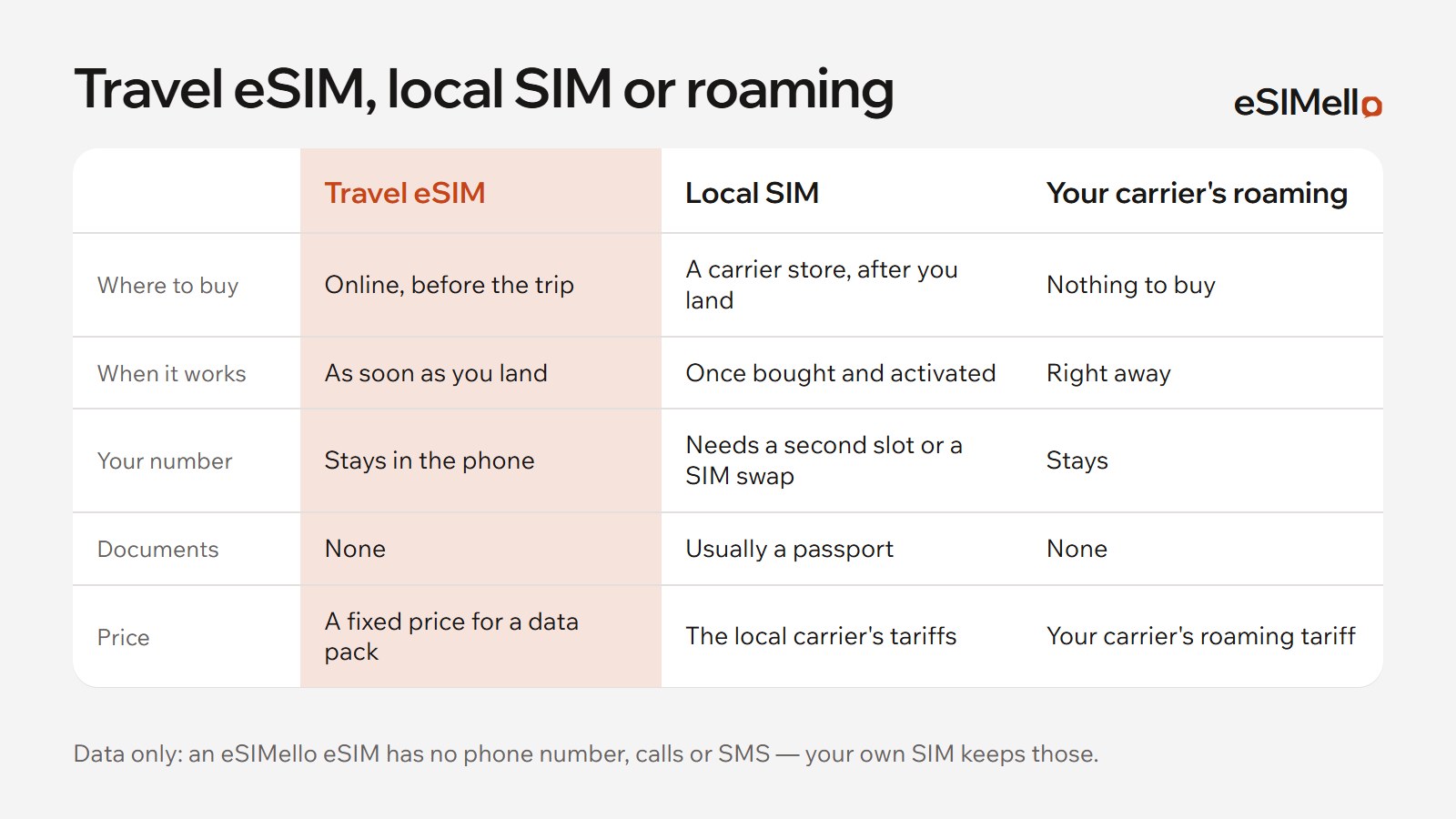
- When the validity starts: when your phone first connects to a network the plan covers, not when you buy or install the eSIM. So you can buy and install it early. Start using it within 180 days of buying it.
- Where the traffic reaches the internet: in Norway or the United Kingdom, so websites see an IP address from there.
- Data only: no phone number, calls or SMS. Keep your own SIM on for those.
- Running low? Top the same eSIM up in My eSIMs, on plans that take a top-up.

Before you fly, and after you land
- Check that your phone supports eSIM, in our list of devices.
- Buy a plan and install the eSIM at home, on Wi‑Fi: step-by-step guides for iPhone and Android.
- After landing, turn on the eSIM's line, choose it for mobile data and turn on data roaming for it. Abroad, a travel eSIM connects through roaming, at no cost beyond your plan.
- Keep data roaming off for your own SIM, so your home carrier doesn't charge you.
If it doesn't connect, see what to check when an eSIM is stuck on “Activating”.